The Author

The author is a practicing lawyer, who began this law blog in 2011.

LAW PRACTICE

The author took the bar in 2015 and passed the same. She went into private practice and taught as a university professor. She entered the public attorneys office in 2017.

Education

The author is a graduate of Bachelor of Arts in Mass Communication and Bachelor of Laws (conferred with Juris Doctor). She is an alumna of Holy Name University.

Leisure

The author loves to write, travel, and write about her travels.

BLOG

Visit her blog: hitchhikersguidetothephilippines.blogspot.com

Sunday, June 23, 2019

Case Digest: People vs. Bartolome (G.R. No. 129486; July 4, 2008)


G.R. No. 129486             July 4, 2008
PEOPLE OF THE PHILIPPINES, plaintiff-appellee,
vs.
GLORIA BARTOLOME, accused-appellant.


Facts:

Gloria Bartolome and Lidelia Capawan were charged with 4 counts of Illegal Recruitment and 4 counts of Estafa when the two allegedly conspired with each other in recruiting 4 private complainants: F. Rollon, R. Dimatulac, E. Buhay and R. Rollon and promising them job placements abroad; and receiving from each of them certain amounts for such purpose without license and/or authority to do so by DOLE.

Capawan remained at large while Bartolome was arraigned and made to face the charges. In Bartolome’s defense, she argued that that she is only being blackmailed by complainants because the wife of her brother-in-law is related to Capawan; it was Capawan who did the recruiting; and that she too is a victim of Capawan.

RTC: Convicted beyond reasonable Ground on all counts

         8yrs and fine P50k -  each for the Illegal recruitment charges
          (6) years, (8) months and 21 days to (8) years – each for the estafa charges

CA: Affirmed RTC with modification.
         The CA increased the penalty to Life imprisonment and a fine of P100k 3   as convict’s crime was classified as Illegal Recrtuiment in a large scale and is considered as involving economic sabotage.


ISSUE: Whether or not Bartolome is guilty of Large Scale Illegal Recruitment

RULING:

         Bartolome is guilty of Large Scale Illegal Recruitment (Art. 39(a) of the Labor Code)

         The Court Ruled that all the elements of Illegal Recruitment were present: First, the offender does not have the required license or authority to engage in the recruitment and placement of workers. Second, the offender undertook (1) recruitment and placement activity defined under Article 13(b) of the Labor Code or (2) any prohibited practice under Art. 34 of the same code.  The acts of Illegal recruitment were further qualified into large scale, because  three or more persons, individually or as group, were victimized.

The first element was present because Bartolome failed to show any license to recruit or engage in placement activities.

The second element was likewise present, when she and Capawan gave the impression that they are capable of sending the four private complainants to Bahrain. All four corroborate each other’s testimony that Bartolome promised employment for a fee. Bartolome even testified that she knew private complainants since childhood and even described them to be “not misbehaving pr perjurious people”. The RTC and CA found their testimony to be believable and the same meets the standard of proof beyond reasonable doubt.

Bartolome’s defense of conveniently passing the blame on Capawan cannot stand. Her version being self-serving and gratuitous. Furthermore, her denial cannot prevail over the positive declaration of the prosecution witnesses.


______
Side issues:

After losing before the Court of Appeals...

*Bartolome's Illegal Recruitment cases were forwarded to the Supreme Court in view of the penalty imposed.

*Bartolome filed a Motion for Reconsideration and, subsequently, a Petition for Review on the CA resolution regarding the Estafa cases. The Petition for Review was dismissed by the CA on the ground, among others, non-compliance with the requirements on making a deposit to answer for cost. The CA desicion, convicting accuse was final and executory and was for all intents and purposes deemed affirmed with finality)

*Bartolome was out on bail. The bondsman failed to bring her to court within 30 days pursuant to Administrative Circular No. 212-9.  Her withdrawing lawyer could not locate her. The NBI and police officers could not serve her warrant. She is deemed to have jumped bail.

Case Digest: Sunace International Management Services, Inc. vs. NLRC


G.R. No. 161757             January 25, 2006
SUNACE INTERNATIONAL MANAGEMENT SERVICES, INC.  vs. NATIONAL LABOR RELATIONS COMMISSION, et al

CASTS

Petitioner – Sunace International (sunace for brevity)
Divina A. Montehermozo – Respondent (The Original Complainant; Divina for brevity)
Edmund Wang – Taiwanese Broker, Press a Jet Crown Intl. (wang for brevity)
Hang Rui Xiong – Divina's Taiwanese Employer (Xiong for brevity)
Adelaida Perez- Owner of Sunace (Adelaida for brevity)

FACTS:

Divina was deployed by SUNACE to Taiwan under a 12-year contract with the help of a Taiwanese Broker (Wang).

When Divina returned in the Philippines in 2000, after her 2 year extension, Divina filed a complaint before the NLRC against SUNACE, Adelaida, Xiong, and Wang because she allegedly was jailed and underpaid by her employer.

In her position paper, Divina claimed for refund for tax deduction and savings deduction while employed in Taiwan; that although deductions made for 1997 were returned, the deductions for 1998 and 1999 were not.

SUNACE'S RESPONSE:
1.         Divina is not entitled to her 24 months savings because she already received the same and that there were no more deductions made against her.

         Proof submitted: Fascimile message 

2.         Divina is not entitled to Tax Refund and Attorney's fees...

        Reason: Divina may only claim if she were illegally dismissed and it may only be given to her by way of damages. However, she was not illegally dismissed; instead her contract ended (end of contract). Ergo, she has no cause of action against Sunace for the monetary claims because she was not illegally dismissed and that she was already given all her benefits under her employment contract.

Also, the tax deducted was pursuant to tax law which which is beyond the control of Sunace.

3.         Sunace didn't know of her 2 year extension.

LABOR ARBITER’S DECISION: Divina Won. Sunace and its owner Adelaide are liable as agents of Xiong and Wang

*Sunace knew of the extension because they've been communicating with Edmund Wang. There was implied consent because Sunace was an "Agent of the Foreign principal".

Sunace should have informed POEA and the Taiwanese employer of its (Sunace's) objection to the extension but it did not.

*ABOUT THE SETTLEMENT AGREEMENT (apparently, there was a settlement agreement), it was contrary to law, morals, and public policy because it should have been 1. Reduced into writing;  2. Signed by parties and  lawyer; 3. in the labor arbiter's presence; and because there was no "consideration"(P.S. Consideration is an essential element of a contract) OR if signed not in the presence of Labor Arbiter (LA):
1.         Labor arbiter should have confronted the parties with the settlement
2.         Explained the terms and conditions
3.         Approved by LA

NLRC- affirmed LA
CA-affirmed LA and NLRC
CA: "Sunace knew because Sunace was  continually communicating with Divina’s foreign employer


ISSUE: Whether or not Sunace is liable to Divina for the monetary claims

RULING: 

Supreme Court- LA, NLRC, CA -WRONG;  "SUNACE NOT LIABLE"

1.         Sunace was communicating with the “broker” Wang, not the foreign employer Xiong
2.         It was wrong to rely on the fascimile message as it contained nothing which would show that Sunace was privy to the new contract (the extension)
3.         Just because Sunace and Wang talked about the withheld savings, it doesn’t mean that Sunace ratified the Contract (extension)
4.         The THEORY OF IMPUTED KNOWLEDGE was misapplied
 -This theory provides that the knowledge of the Agent is the knowledge of the principal (if the agent knows, the principal also knows)... NOT THE OTHER WAY AROUND. The knowledge of the principal is not the knowledge of the agent.
5.         There is an implied revocation of the AGENCY RELATIONSHIP with its foreign principal when the foreign principal directly negotiated with Divina.

 - - - - - - - - - - - - - - - - - - - - - - - - - - - - - - - - - - - - - - - - - - - - - - - - - - - - - - - - - - - -

"There being no substantial proof that Sunace knew of and consented to be bound under the 2-year employment contract extension, it cannot be said to be privy thereto. As such, it and its "owner" cannot be held solidarily liable for any of Divina’s claims arising from the 2-year employment extension. As the New Civil Code provides, “Contracts take effect only between the parties, their assigns, and heirs, except in case where the rights and obligations arising from the contract are not transmissible by their nature, or by stipulation or by provision of law."


Thursday, June 20, 2019

Slow Reader in Law School

Are you one of those law students who feel frustrated when they've only covered 5 pages of a book they've been reading for an hour?

Storytime:
I read as fast as I talk... and I talk as fast as roadrunner could run. In short, I'm quite a fast reader. Give me a novel, any book, and I'll devour it in a jiffy.
But when I entered law school as a freshman years ago, it was as though I've lost all ability to comprehend words when stitched together in a sentence. I averaged 5-10 pages in an hour... 20 when I'm not paying attention (only to spend another hour re-reading the same thing all over again). I was that slow. While my mates were done with a chapter, I have just turned a page.
You might think I'd improve my speed when I reached senior year after years in law school, but that's not quite the truth. I read just as slow. Well., ok... perhaps I've improved quite a little when I was already on my 3rd reading--- probably 5 more pages faster. Still, that's slow compared to reading other kinds of book, which one can finish in an hour or two.
BUT...
Everything I've read since my first ever lawbook, I still remember (or at least comprehend) until now.
I was reading slow because, even though I was time-aware, I was more concerned with the quality of how I was reading rather than the amount of materials I was reading.
I was reading slow because I had to methodically examine every word in a paragraph; to pick out salient points; to make sure I retain only the important stuff; to remember; and most importantly, to understand.
When I was reading slow, I was giving my brain time to process the information; Clean parts of my brain to make room for it... to make sure the data has a home where it can remain there.
I didn't blame my brain for working slowly. Instead, I was patient with it... with myself. That's how you make an ally of yourself in the long run, patience.
So if you're going through the same struggle, do not be discouraged. It is part of the process. Trust me when I say things will get better and you will improve.
No baby learned to run without first learning to walk. 
Now, go back to that book, you procrastinator, you! Enjoy!
-Atty. Lapadiday♥
#slowreader
__________________
Survey
How many pages of a lawbook can you read in an hour?
A. 1-10
B.10-20
C. 20+
D. What read?

Tuesday, June 18, 2019

DOWNLOADABLE PETITION FOR NOTARIAL COMMISSION

CLICK HERE TO DOWNLOAD A PDF/WORD COPY

The link will redirect you to the download page.

INSTRUCTION:
Edit the ones in Red and attach the necessary (properly labeled) Annexes.

For questions, feel free to leave a comment on the comment box below.


Don't forget to like our Facebook Pagehttps://www.facebook.com/attylapadiday/.
You may also reach me there.

-Atty. Lapadiday

Friday, March 29, 2019

Conditional admission Application Form and Undertaking for AY 2019-2020

Download the form HERE


Tuesday, March 19, 2019

April 7, 2019 PhiLSAT to push through


Monday, March 18, 2019

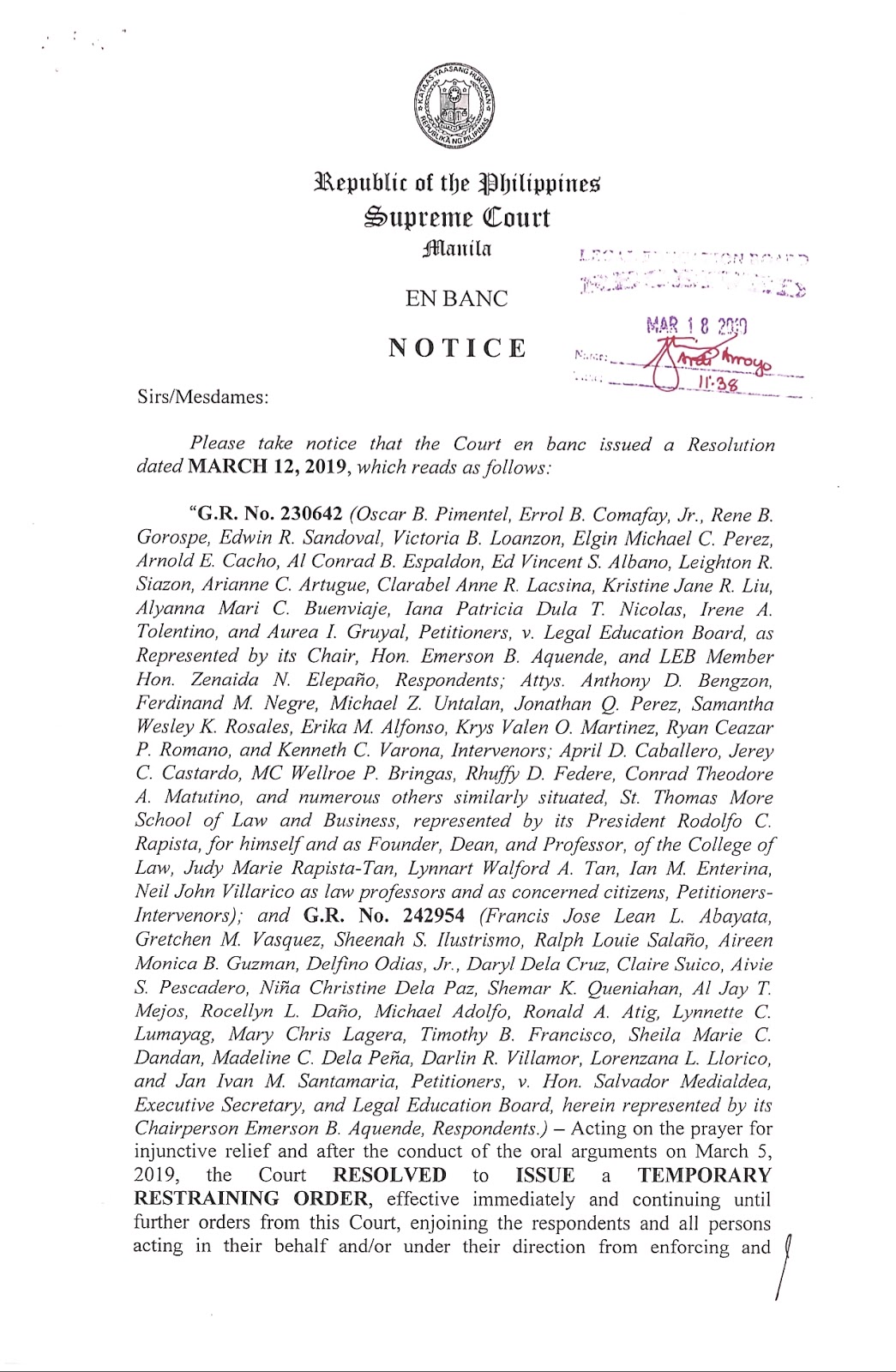
G.R. NO. 230642 & 242954: SUPREME COURT TRO ON PHILSAT